 Hair Care
Hair Care
No Reviews
$29.99
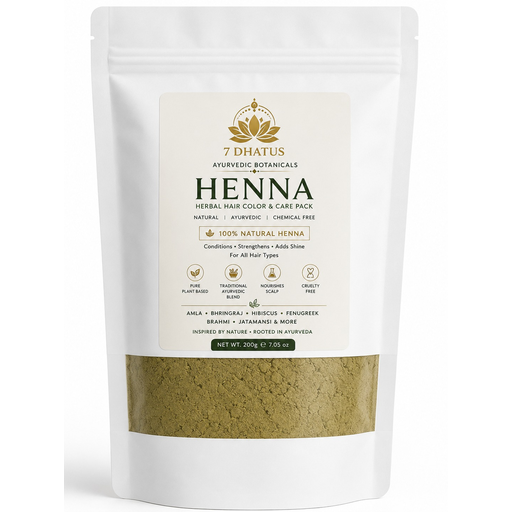
Experience the timeless beauty of an Ayurvedic-inspired botanical hair-coloring ritual. 7 Dhatus Kesha Ranjana is thoughtfully formulated with seven selected botanicals—Henna, Amla, Katha, Bhringraj, Fenugreek, Hibiscus, and Jatamansi—to impart rich, multidimensional color while enhancing the appearance of shine, body, and softness.
At the heart of the formula is pure henna, traditionally used to impart naturally radiant copper, auburn, and reddish-brown tones. Amla, Katha, and complementary Ayurvedic botanicals create a sophisticated botanical blend designed for those seeking a more traditional approach to hair coloring.
Each pack includes a Color-Enhancing Botanical Tea Bag with Coffee, Beetroot, and Katha to complete the 7 Dhatus coloring ritual.
For dark brown to near-black color and enhanced gray coverage, follow with the 7 Dhatus Indigo Color Ritual.
Formulated by a Licensed Cosmetologist, Certified Trichologist & Certified Ayurvedic Practitioner.
Color-Enhancing Botanical Tea Bag
Coffee (Coffea arabica)
Beetroot (Beta vulgaris)
| Ingredient | Botanical Name | Website Benefit |
|---|---|---|
| Henna | Lawsonia inermis | The foundation of the ritual, henna naturally deposits warm copper, auburn, and reddish-brown tones onto the hair while enhancing visible shine and body. |
| Amla | Phyllanthus emblica | Traditionally valued in Ayurvedic hair care; complements henna by helping create a deeper, less intensely orange color profile while supporting a conditioned appearance. |
| Bhringraj | Eclipta prostrata | A celebrated Ayurvedic hair herb traditionally known as Kesharaja, or “king of the hair,” included to enrich this botanical hair-care ritual. |
| Hibiscus | Hibiscus rosa-sinensis | Adds botanical richness to the formula and complements warm burgundy and auburn color tones while helping hair feel soft and look lustrous. |
| Fenugreek | Trigonella foenum-graecum | Adds natural slip and conditioning feel to the henna paste, helping improve manageability and reduce the dry feel sometimes associated with botanical coloring. |
| Katha / Catechu | Senegalia catechu | Traditionally used for its naturally rich brown tones and included to add greater depth and dimension to the henna color ritual. |
| Jatamansi | Nardostachys jatamansi | A treasured Himalayan Ayurvedic botanical that gives the formulation a distinctive, luxurious traditional character |
1. Clarify the hair.
Before application, wash hair thoroughly with a clarifying shampoo to remove oil, silicone, conditioner, styling products, and residue. Do not use conditioner after shampooing.
2. Prepare the botanical tea.
Place the enclosed Color-Enhancing Botanical Tea Bag in 1 cup of hot water. Steep for 10–15 minutes.
3. Prepare the henna paste.
Allow the prepared tea to cool until warm. Gradually mix it into the henna powder until a smooth, yogurt-like paste is formed.
4. Allow for dye release.
Cover the paste and allow it to rest for approximately 4–6 hours.
5. Apply generously.
Wearing gloves, apply the paste generously to clean hair, fully saturating the roots and gray areas.
6. Processing time.
Leave on for approximately 2–3 hours, particularly for resistant gray hair.
7. Rinse.
Rinse thoroughly with water. Do not shampoo immediately after application.
8. Allow the color to develop.
The botanical color may continue to deepen over the next 24–48 hours.
9. Oil before shampooing.
The following day, apply a small amount of hair oil before shampooing to help the hair feel soft and conditioned.
Holistic Ayurvedic consultations, wellness programs, and natural products designed to restore balance for mind, body, and spirit.

16 Delapa Circle Walpole, Massachusetts 02071

7817624239

Copyright © 2026. All Right Reserved.